
SMSF Record Keeping That Shows Its Working
Harbour keeps a self-managed super fund's records all year and hands the accountant and auditor a reconciled pack, every original document with a fingerprint, the bitcoin proven from the blockchain, and a file their own software can import. Here's how it works and what it turned up.
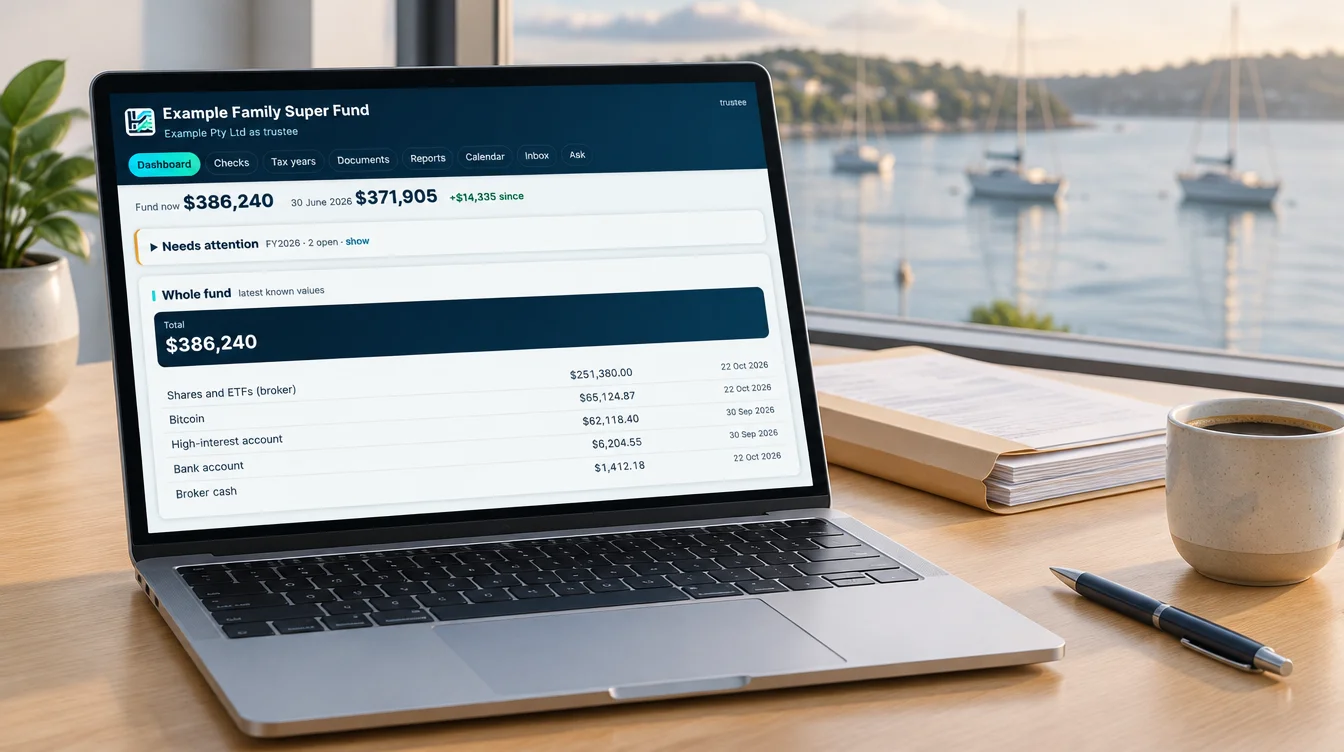
Ask an SMSF trustee how they get ready for the accountant each year and the honest answer is usually a box. Statements, dividend advices, contract notes and tax statements go into it all year, and once a year it’s handed over. The accountant sorts it, the auditor asks for whatever is missing, and both bill for the hours.
We’ve built Harbour, an SMSF record keeping system that keeps a self-managed super fund’s records as the year goes, not at the end of it. The first fund on it is small: one member in accumulation phase, a company as trustee, an online broker holding ETFs and a few shares, a bank account, a high-interest cash account, some gold and some bitcoin.
The goal was never to replace the accountant or the auditor. The audit still happens. The aim is to hand them a year that’s already sorted, checked and evidenced, so they spend their time on judgement instead of collating.
SMSF record keeping starts at the inbox
The fund has its own email address. Registries, the broker and the bank send their notices there, and Harbour checks it every morning. New PDFs are copied into the fund’s document folder under names that can’t clash with anything already there. Nothing is ever moved, edited or deleted. The originals are the evidence.
An AI reads each document into a fixed set of fields: a distribution advice gives the payment date, units and the cash, franked and unfranked amounts; an annual tax statement gives the capital gains, foreign income, tax offsets and cost-base adjustments. Then the code checks every field, and every total, tax figure and cost base is worked out by ordinary tested code, never by the AI. Money is held as exact decimals and dates are Melbourne dates.
Some notices come with no PDF at all. The broker’s “cash has arrived” email just says an amount landed. Harbour matches it to the payment advice it belongs to, within a week either way, and if nothing matches it says so. When the morning check finds something worth knowing, the trustee gets a short email, much like the morning briefing in our Helm private assistant. Otherwise it stays quiet.
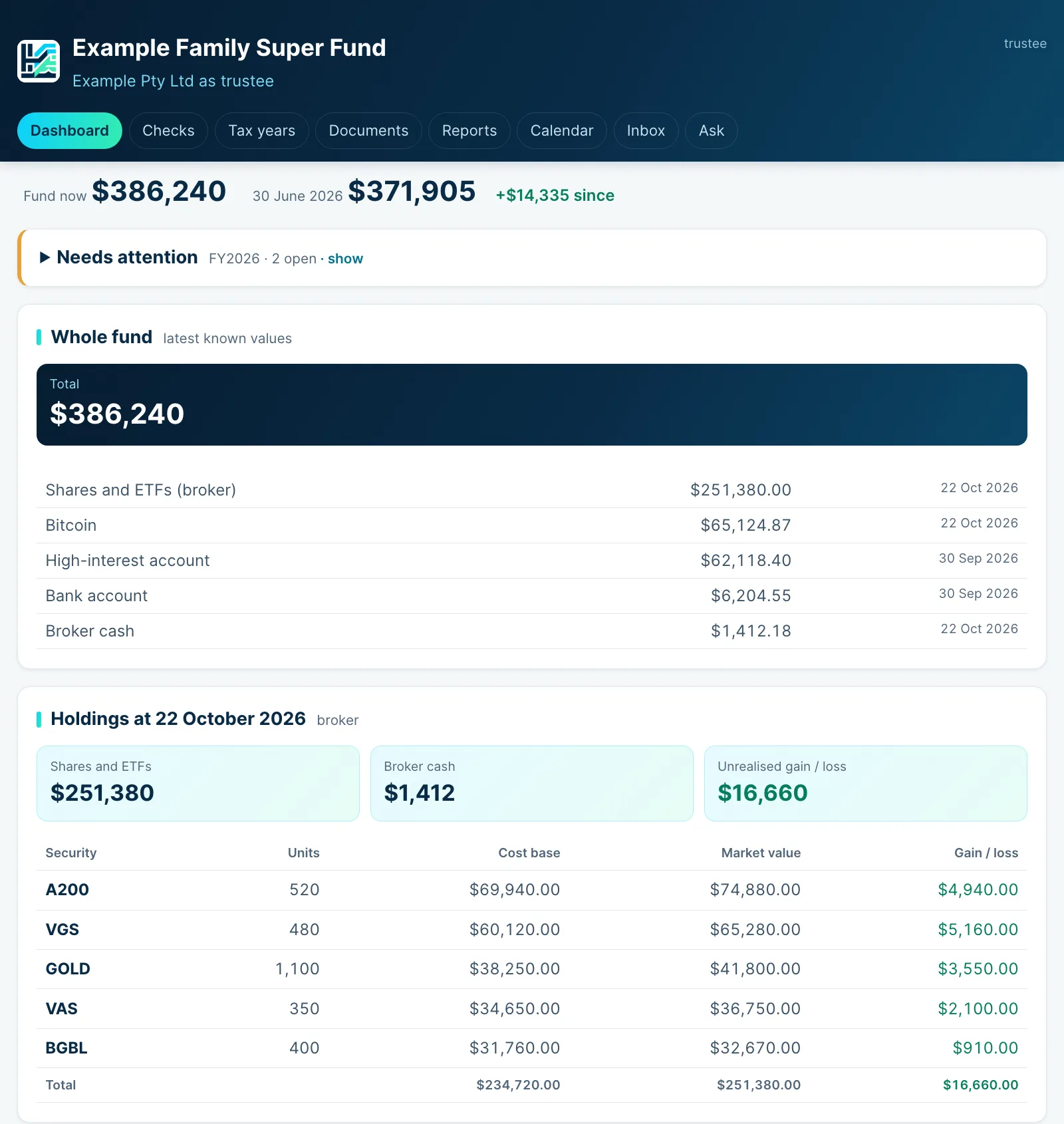
The dashboard: what the fund is worth, where it sits, and what still needs doing. (Sample fund and figures.)
Everything ties to something
A record is only as good as the thing it’s checked against, so Harbour checks everything against something independent:
- Holdings against the broker. Harbour rebuilds every holding from the trades, contract notes and reinvestments it holds, then compares the result with the broker’s own holdings report. They must agree to the unit. If they don’t, a document is missing, usually a reinvestment advice.
- Tax statements against payments. An ETF’s annual tax statement says how much cash it paid for the year. The year’s payment advices must add up to exactly that. A gap means an advice is missing; no statement means it hasn’t been downloaded yet.
- Cash against the bank. Each account’s balance must match its statement, and money moving between the fund’s own accounts must be matched at both ends.
Anything that doesn’t tie becomes a to-do with a dollar figure next to it. That list is, more or less, the chasing an accountant normally bills for.
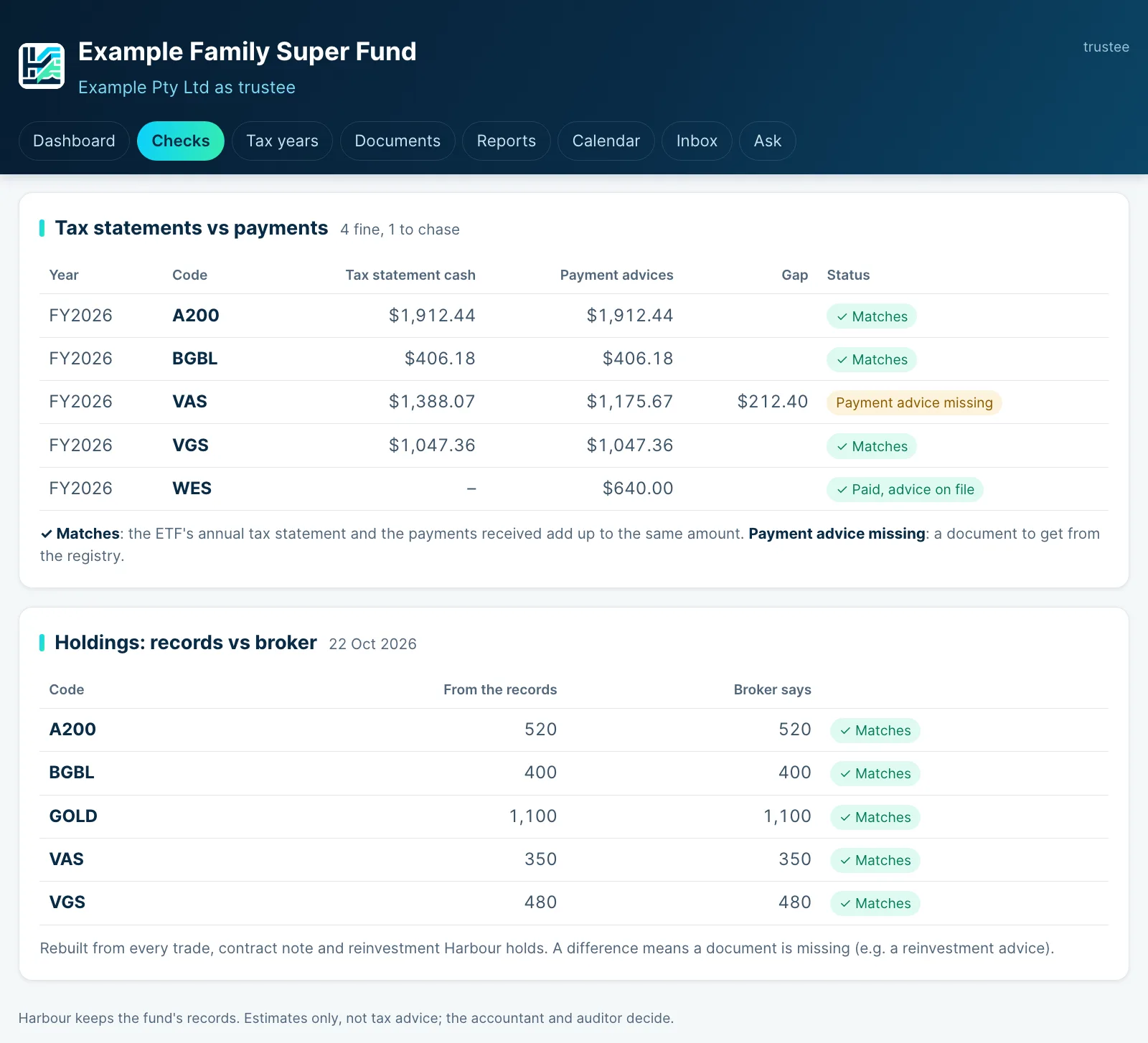
Checks: one payment advice to chase; every holding agrees with the broker. (Sample figures.)
Tax rules that change from year to year, such as contribution caps and the supervisory levy, are kept in one place with the source for each figure. If a year isn’t there, Harbour won’t guess it.
The auditor wants the originals
At year end Harbour produces a pack: one PDF with every schedule (the tax estimate line by line, investments at 30 June with cost base and market value, every capital gains event by parcel, income with its franking and trust components, the cash accounts, contributions and the rollover), plus the same schedules as spreadsheets. Every line names the document it came from.
The accountant liked it, and then pointed out the obvious: the auditor needs to see the original documentation, not a summary of it. Fair enough. So Harbour now builds an evidence bundle, one zip with every original behind the year’s figures, sorted into folders: bank and cash, investments and trades, income and tax statements, crypto, contributions and rollovers, trustee and compliance papers, and the pack itself.
The first file in it is an index. It lists every document, what it supports, and its SHA-256 fingerprint, so the auditor can confirm each copy is exactly what Harbour filed. Identical copies go in once, working files and anything personal stay out, and the bundle ends with a plain list of what isn’t on file yet.
That list earned its keep straight away. Two of the papers an auditor checks every year weren’t on file for this fund: a signed trustee declaration and a written investment strategy. Both were fixed the same week. Harbour drafted the strategy and the minute adopting it from the trustee’s own choices (target ranges for each asset class, including the bitcoin), and the signing copy is dated the day it’s signed. It’s never backdated.
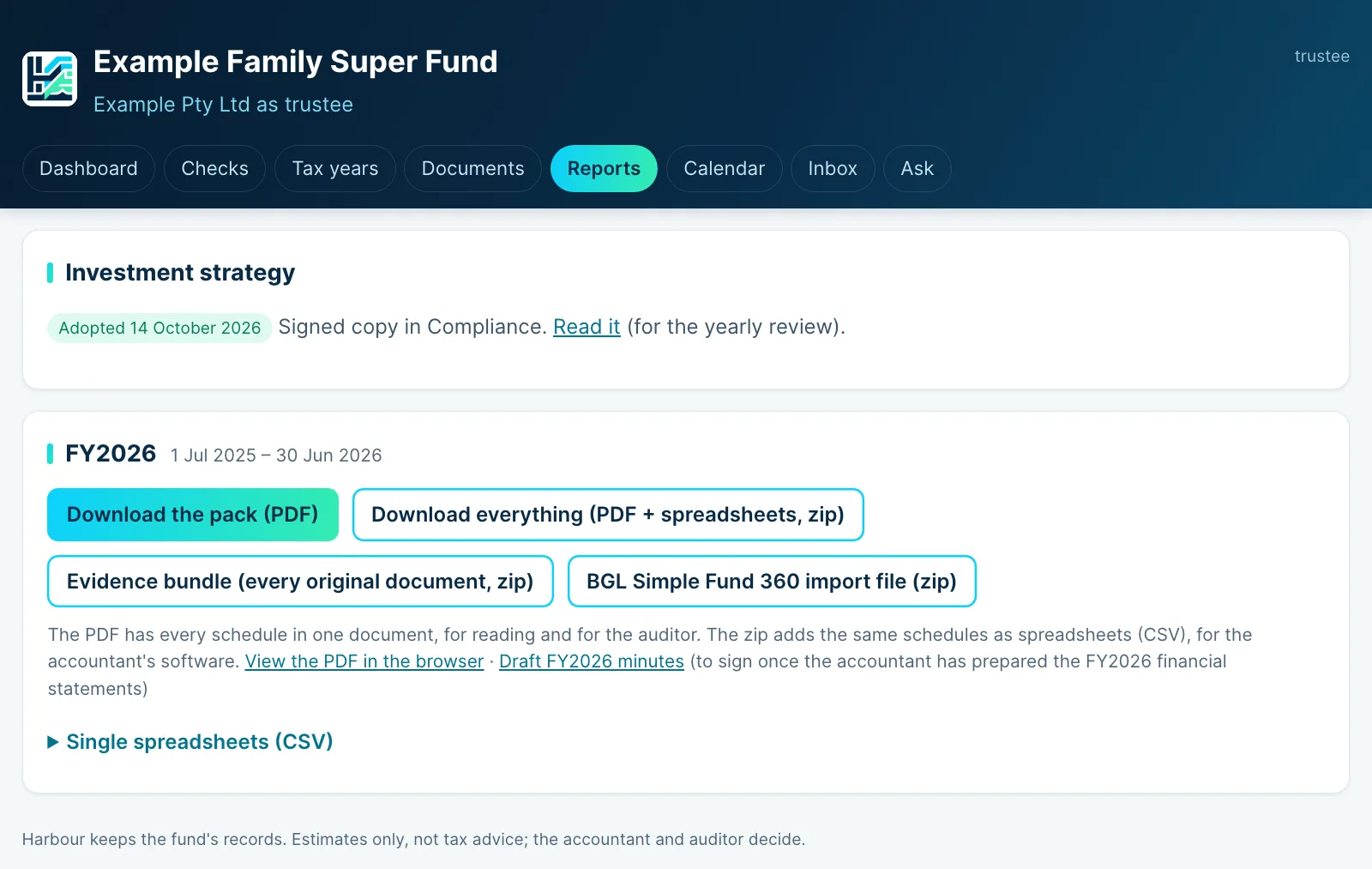
Reports: the pack, the evidence bundle and the accountant’s import file, one click each. (Sample fund.)
Proving the bitcoin from the blockchain
Crypto is where SMSF audits get awkward. The auditor has to be satisfied the coins exist, belong to the fund and are worth what the accounts say at 30 June (the ATO sets out what auditors check). The usual evidence is a screenshot of a wallet app, which proves very little.
Bitcoin has a better answer built in: its ledger is public. Harbour takes the fund’s wallet addresses from its records, fetches every transaction on them from a public block explorer, keeps a dated copy, and checks the balance at 30 June against the books. For this fund it agreed exactly. The record goes into the evidence bundle with a link for every transaction, so the auditor can check any of them independently.
To be straight about the limits: the chain shows where the coins are, not who holds the keys. That link comes from the exchange statement, which shows the coins being bought with the fund’s own money and withdrawn to those same addresses. Together they tell the whole story.
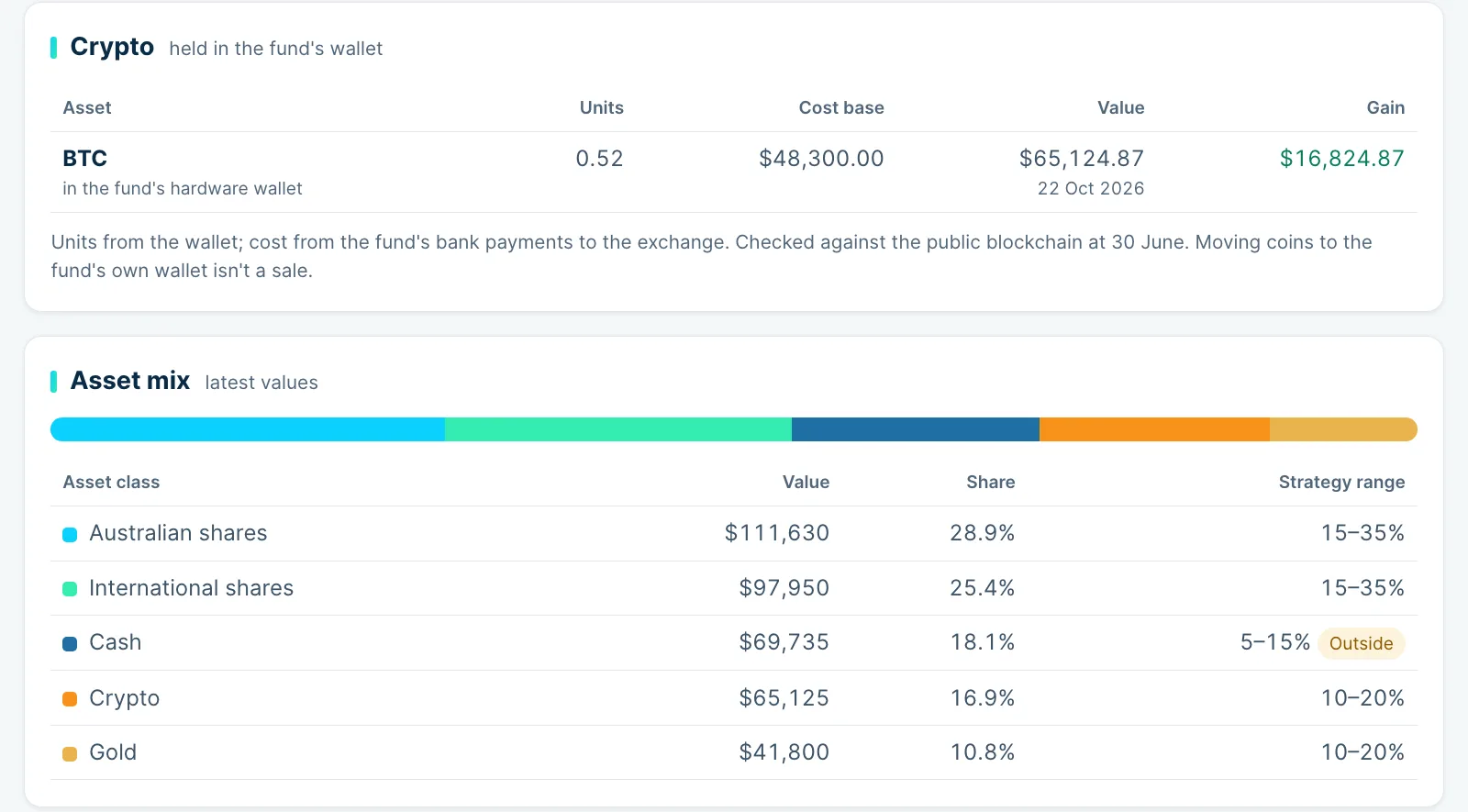
The bitcoin, valued and checked, and the fund’s mix against its strategy, with cash flagged as outside its range. (Sample figures.)
Meeting the accountant’s software
Most SMSF accountants work in dedicated software, and this one uses BGL Simple Fund 360. BGL’s usual route is to connect bank and broker feeds, but for this fund they weren’t connected, which would normally mean keying the year in by hand.
So Harbour writes the year in BGL’s own import format. One file holds every line on the bank, high-interest and broker cash accounts; every dividend and distribution with its franking and foreign tax (with June distributions paid in July accrued back to 30 June); and every buy and sell, including the bitcoin purchases. Each cash account reconciles to its 30 June statement balance before the file is written. The trust tax components are left to BGL’s own distribution processing, which works from the same annual tax statements in the evidence bundle.
The file comes with a read-me on how to load it. The accountant uploads it to BGL’s import feed and the whole year arrives: no keying in, no feeds to set up. If anything ever maps wrongly, the import can be undone in one step, and the file fixed and sent again.
The accountant stays in charge
Harbour prepares; it doesn’t decide. Every page says so, and so does every pack: estimates only, not tax advice; the accountant and the auditor have the final say.
The accountant can have a read-only login to see the same figures live during the year and download the pack themselves. The trustee also has an Ask box: questions in plain English, answered by an AI that can look but not change anything, and that quotes every figure from Harbour with its source rather than working anything out. Once a year’s pack has gone to the accountant, history is never rewritten. A correction is a new record beside the old one.
Three things worth knowing if you run an SMSF
Building this meant reading the rules closely. A few are worth passing on, whatever you use to keep your fund’s records.
The 45-day rule applies to every franked dividend. To claim a franking credit, shares generally have to be held “at risk” for at least 45 days around the ex-dividend date (the ATO’s holding period rule). Individuals often fall under the small-shareholder exemption and never think about it. A super fund can’t use that exemption, so a short trade around a dividend can quietly cost the franking credit. Harbour checks every franked dividend; it caught one, and the accountant confirmed it.
US-listed funds and the W-8BEN. Dividends from US-listed ETFs have US tax withheld, at 30% unless the fund has lodged a W-8BEN form with the broker, in which case the treaty rate of 15% generally applies. Only the 15% can usually be claimed back as a foreign tax offset, so without the form the difference is simply lost.
The investment strategy has to keep up with the fund. A written strategy is required, and it should cover what the fund actually holds. If you add crypto, the strategy should say so, give it a range, and say how the risk and concentration were considered. Review it at least once a year and minute the review.
As with anything tax, check with your own accountant. Ours was quick to add detail to every one of these.
Who Harbour is for
Harbour isn’t an off-the-shelf product. We built it around one fund: its broker, its bank, its assets and its accountant’s software. The same approach works for any fund with a similar shape, and it’s built to be set up for others.
To be straight about it: for plenty of trustees an SMSF administration service, or simply a good accountant and a tidy box of statements, is the right answer. Harbour makes most sense when you’d rather keep the records yourself and have them checked every day, when the fund holds things the usual services handle awkwardly (crypto in your own wallet is a common one), or when you want your accountant and auditor to start from a year that’s already reconciled.
If you’re a trustee or an SMSF accountant and SMSF record keeping like this sounds useful, book a chat. We’d like to hear what you’d want it to do.
The rule underneath it is the one we use in all our AI work, including Keel, our AI bookkeeping system. Let the AI do the reading and sorting it’s good at. Keep every figure in plain, tested code, check everything against something independent, and leave the decisions with the people who are accountable for them.
Something in your business look like this? We build the software, websites, automation and AI that fix it — and the writing that goes with them.
Book a chat →