
Why We Built Dropbucket
We were paying every month to send our own files, from someone else's servers, under someone else's logo. Dropbucket is the tool we wanted instead: branded send and request links, files up to 5 TB, and everything stored in a bucket you already own.
A lot of what 38South makes is video, and video means big files. Masters going out to clients, rushes coming in from shoots, selects going back and forth for review. For years we did what everyone does: paid a monthly fee for a file transfer service.
It always sat a bit wrong. We were paying rent to send our own work. The files sat on someone else’s servers for as long as that company decided, and every delivery went out with their logo on it, not ours. Meanwhile we already had cheap cloud storage of our own, doing nothing more exciting than holding backups.
So we built the tool we wanted. It’s called Dropbucket, and it’s now open to everyone.
What it does
Dropbucket connects to a storage bucket you own. That can be Cloudflare R2, Backblaze B2, Wasabi, Amazon S3, iDrive e2 or DigitalOcean Spaces. You paste in an access key, Dropbucket checks it can write, read and delete a test file, and sets up the browser access rule for you.
Then you do two things with it.
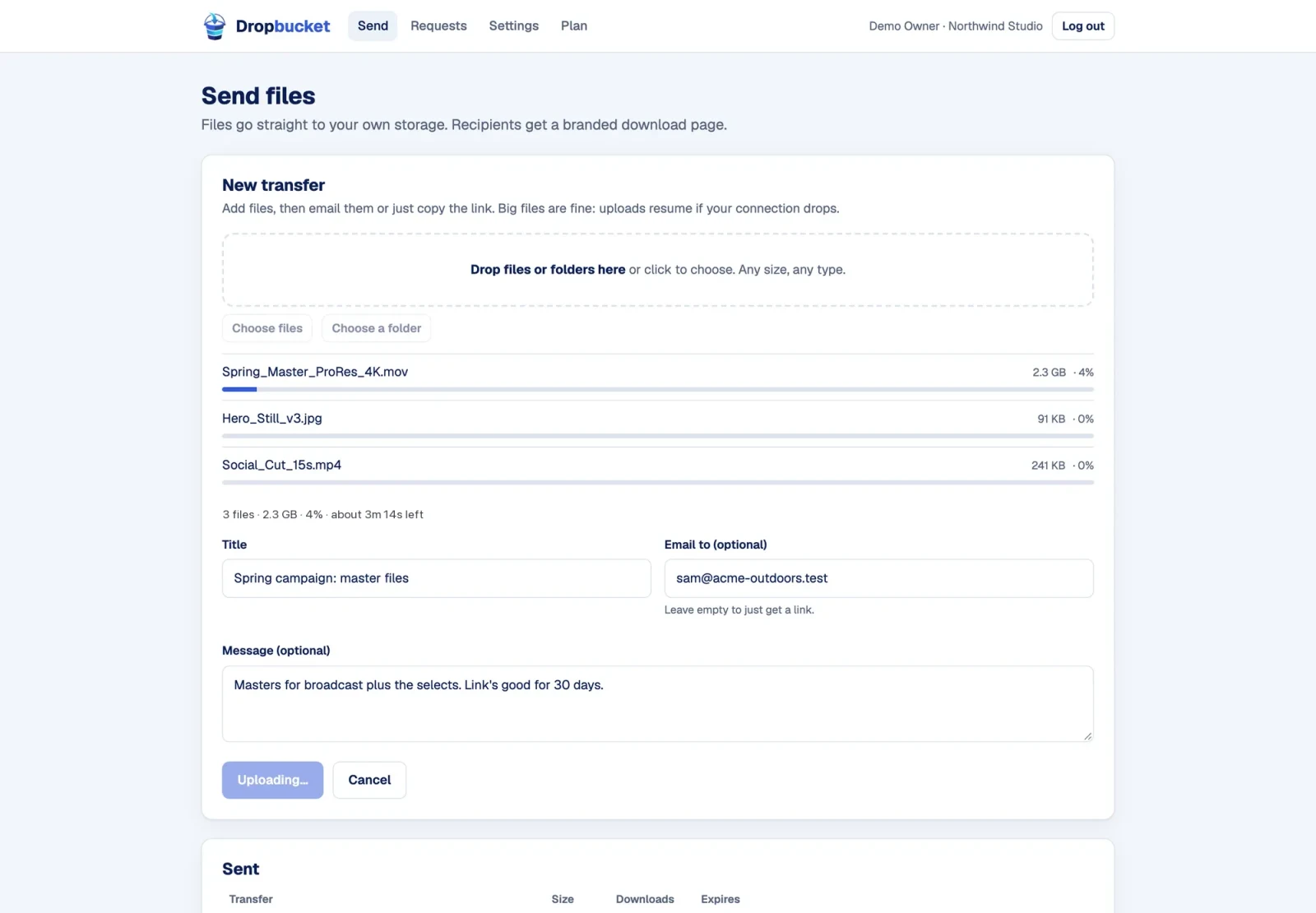
Send. Drag in files or whole folders, and you get a link to a download page with your logo, your colours and your welcome line on it. Email it to up to 20 people or just copy the link. Set an expiry, add a password if it’s sensitive, and get an email when the client actually downloads it. No more “did you get it?”
Request. Send a client a request link and they can drop their footage, raws or a whole project folder straight into your bucket. They don’t need an account or an app. Each person who uploads gets their own private batch, so two people using the same link can’t see or touch each other’s files. You get an email when they’re done, with who sent what.
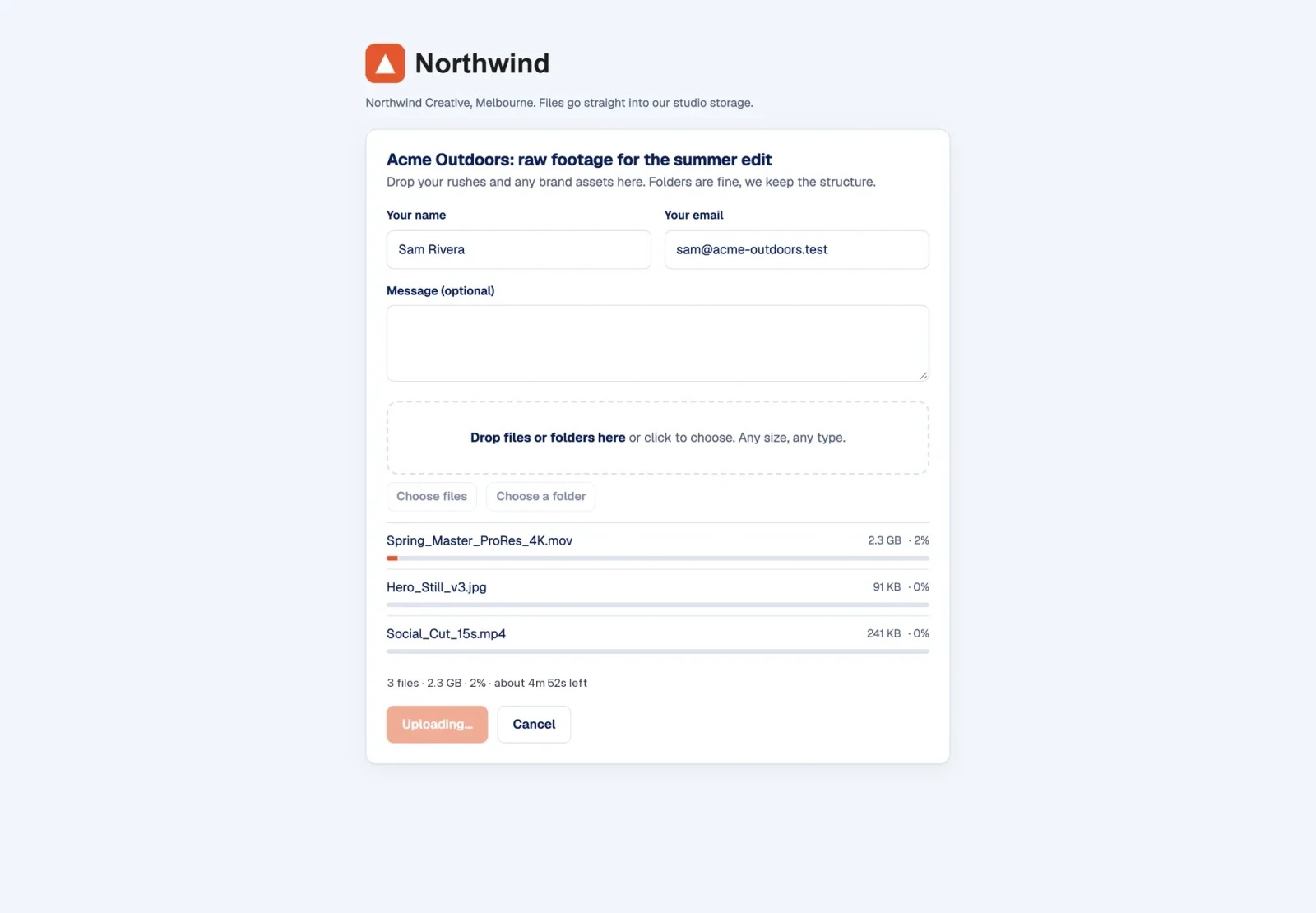
Northwind, the studio in these screenshots, is an example. The screens are the real product.
Your files never touch our servers
This is the part that makes the whole thing work. When you upload, your browser sends the file straight to your bucket. Dropbucket’s job is to hand out short-lived permission slips (signed links, in storage terms) that let the browser put that one file in that one place, and nothing else. Downloads work the same way in reverse: the client’s browser pulls the file straight from your bucket.
That has three useful consequences.
First, there’s no size cap from us. A single file can be up to 5 TB, which is the limit the storage providers set.
Second, we don’t charge per gigabyte, because we never carry any gigabytes. Your storage provider bills you for what you keep, at their price. Cloudflare R2, for example, lists about a cent and a half per GB a month with no download fees, so keeping 500 GB of deliveries costs around US$7.50 a month.
Third, if you ever stop using Dropbucket, nothing has to be moved. Your files are plain files in your own bucket, readable by any storage tool. You can export your account data any time too.
Built for big files and bad connections
The upload engine didn’t start as a product. We built it for our own deliveries, because sending a multi-gigabyte master over hotel Wi-Fi is how you learn what breaks.
Files go up in parts, several at once. The part size grows with the file, and the number of parts in flight goes up when the connection is healthy and drops back when it isn’t. A part that fails gets retried, an upload that stalls gets restarted, and if the connection disappears entirely it waits for it to come back.
The bit we’re proudest of is resume. If the connection drops, the laptop sleeps or someone closes the tab, adding the same files again picks up from the last finished part instead of starting over. We tested it by cutting the network partway through an 800 MB upload and reloading the page. When the file was added again, only the missing parts went up.
Your brand, not ours
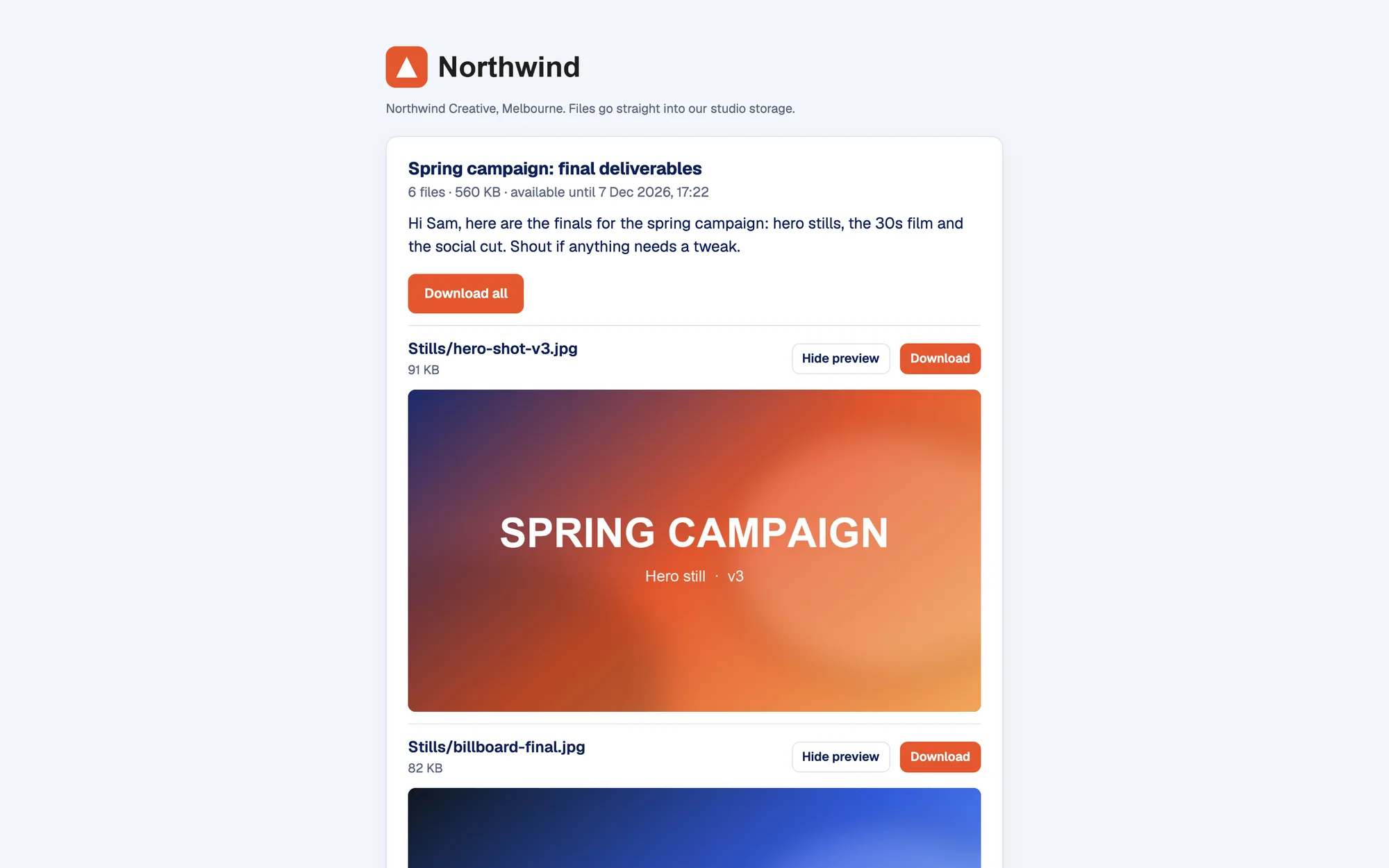
Clients land on a page that looks like it came from you. Images, video and audio can be previewed before anyone downloads anything. On the paid plans you can put links on your own domain, like files.yourstudio.com, and run separate brands for different clients, which is handy for agencies.
One payment, not a subscription
There’s a free plan with no card and no trial clock: one brand, one user, ten live links at a time, and a small “Sent with Dropbucket” badge.
The paid plans are a single payment, not a monthly fee. At launch, Solo is US$39, Studio is US$89 and Agency is US$169, and those prices go up after launch. For comparison, WeTransfer’s top personal plan is US$228 a year as we write this, and team plans on most transfer services charge for every seat, every month.
That’s the same thinking we bring to client work. Own your data, own your brand, and don’t pay rent where a one-off cost will do.
Something in your business look like this? We build the software, websites, automation and AI that fix it — and the writing that goes with them.
Book a chat →