
Helm: The Private AI Assistant That Actually Works For You
What a private AI assistant for small business actually does day-to-day: the 7am briefing that turns inbox clutter into a 30-line to-do list, the overnight job that turns the till's sales file into something you can actually read, the 53 deliberate actions it can take — and the clear limits that keep your accounts and inbox under human control.

Every small business in the country is being sold AI at the moment. Most of it arrives as a chatbot bolted onto a website, or a subscription to something that writes vaguely-worded emails. It demos well. It rarely survives contact with a real working week.
The version we build looks different, and it’s worth describing plainly — because “AI assistant” has been used to mean so many things that it’s stopped meaning much at all.
Two halves that need each other
An assistant needs two things: a brain that talks and remembers, and somewhere to put what it knows. Our product, Helm, is both halves wired together.
The brain is Hermes, an open-source agent from Nous Research. It lives in the messaging apps you already use — we recommend Telegram, because the format is far better for this than the alternatives — and, crucially, it remembers. It learns how your business works, picks up new skills as it goes, and doesn’t forget how it solved something last time.
The other half is Helm itself: the structured side, and the part we build. A task board, a calendar, notes, a page for every supplier, customer and regulator you deal with. It’s where the agent puts things, and it’s where you go when you’d rather look at your week than have a conversation about it. There’s an app on the desktop and on your phone.
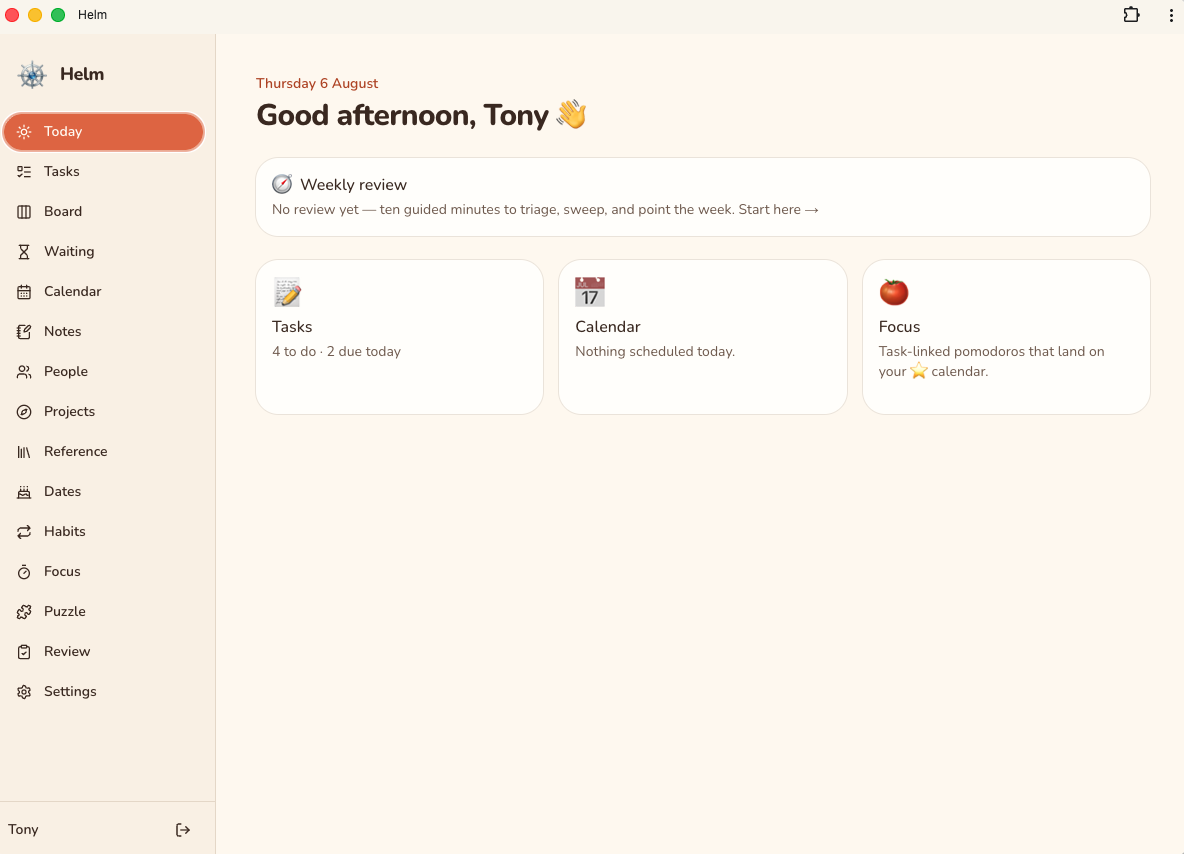
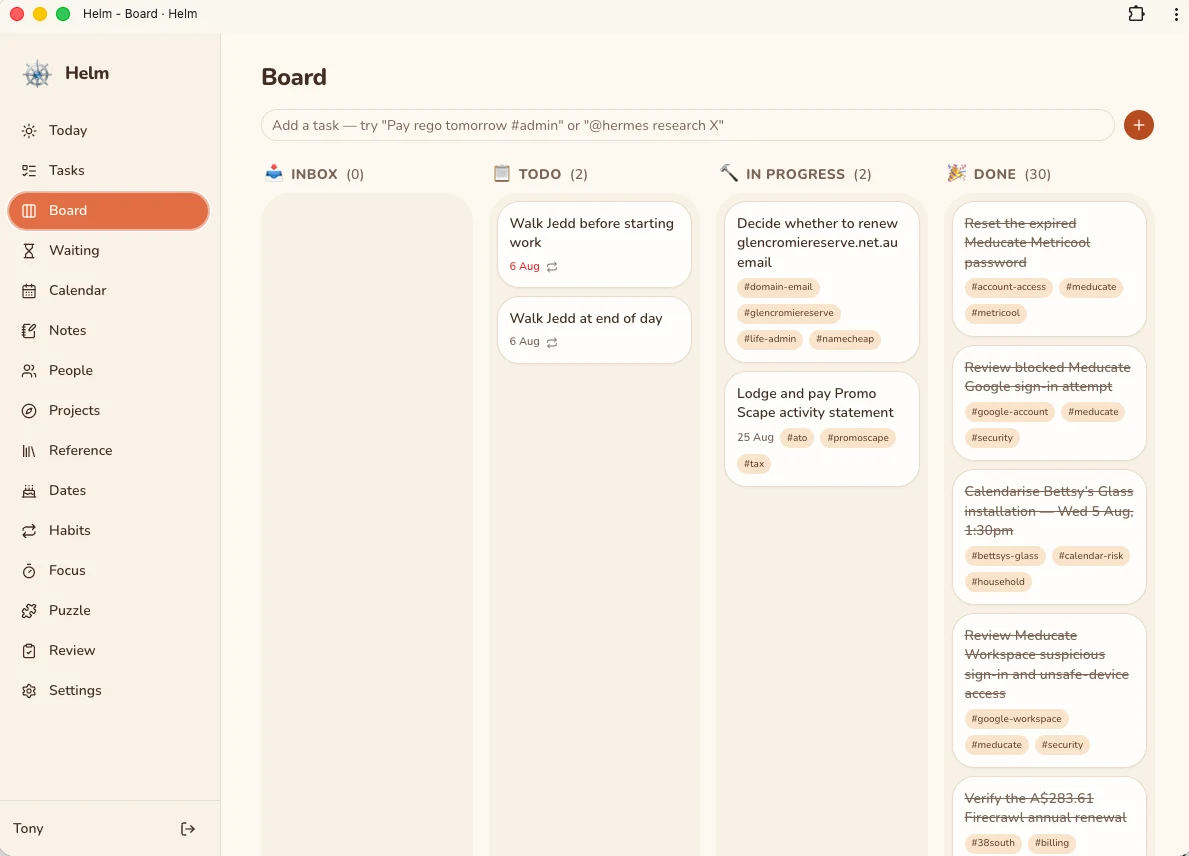
Chat for the back-and-forth. The board for the overview. Neither half is much use on its own; together they’re an assistant.
What it does all day
Abstract descriptions of AI are useless, so here’s a working day instead. The business below is invented — an independent bookshop — and we’ll say that plainly, because we don’t normally make things up. The shop is an example. The work is not.
7:00am — the briefing. Overnight, the agent has read every inbox and turned anything that needs action into a task with a due date. This morning that means: the Watson family emailed about their special order — three cookbooks — and need a reply. Smith Joinery still hasn’t been chased for the shelving quote, and their quote actually arrived last week, so it’s sitting there ready to review. The Penguin delivery lands at two on Tuesday morning, the BAS call with the accountant is Wednesday. It’s capped at thirty lines, because a briefing you don’t read isn’t a briefing.
Midday — usually nothing. Unless a bill falls due today or a significant order lands, the agent says nothing at all. The owner is on the floor selling books. An assistant that interrupts you for nothing isn’t an assistant, it’s a notification.
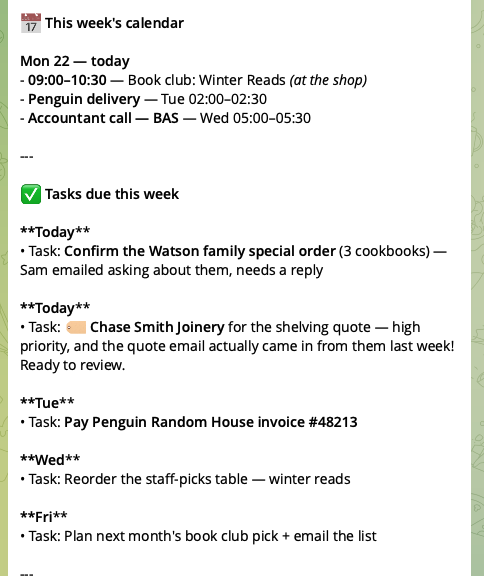
5:00pm — the wrap. What came in, what got cleared, what’s due tomorrow.
10:00pm — the unglamorous bit. The till exports a sales file every night: hundreds of rows nobody has ever read on purpose. Each night the agent takes the day’s file, works out what actually sold, what’s running low, and which special orders can be filled out of Tuesday’s delivery, and turns it into a summary the owner can scan in seconds over breakfast. Come BAS time, the quarter’s numbers are already sitting there labelled — not a shoebox job for a lost Sunday.
None of that is clever, exactly. It’s just work that was never going to get done otherwise.
What the assistant is actually allowed to touch
This is the part that separates a working assistant from a chat window, and it’s worth being specific about.
Helm gives the agent fifty-three defined actions — not free rein over your systems, but a fixed set of things it can do, each one built deliberately. It can read and search your email, turn a message into a task, snooze one until Thursday. It can create, update and complete tasks, add and move calendar events, write and search notes, and record a decision so that in six months you can find out why you did something.
A few are worth calling out, because they’re the ones people don’t expect.
“Brief me before this call.” Ask about a person and it returns everything the business knows about them in one go: when you last spoke, recent email in both directions, meetings with them in the last couple of months, every open task that mentions them, and any notes that link back. Not a search result — a briefing. That single action is impossible for a standalone agent, because none of that information is anywhere it can reach.
Things you’re waiting on. You can tell it someone owes you a quote, and it will carry that until it’s resolved and nudge when it goes stale. Most small businesses lose more money to forgotten follow-ups than to anything dramatic.
It asks before it remembers. When the agent works something out about your business that it thinks is worth keeping, it doesn’t just absorb it. It files a proposal, and you approve or reject it. Its long-term memory is something you curate rather than something that quietly accumulates and drifts.
You can see what it did. There’s a running record of the agent’s own activity. If you ever want to know what it touched last Tuesday, that’s a question with an answer.
The part people don’t expect: what it won’t do
The most reassuring thing about a well-built assistant is where it stops.
It drafts email replies, and saves them for review. It does not send them. Anything touching the accounting system needs a code from the owner’s phone before it can log in — deliberately, so the machine can prepare the numbers but can’t wander around in them unsupervised. When a task has already been moved to “in progress” on the board, the agent leaves it alone rather than nagging about it.
An assistant that quietly does things to your business while you’re not looking is not a feature. Every one of those limits was a design decision.
A machine of its own, not a seat on a platform
This is the part that matters most, and it’s where we differ from nearly everything else on the market.
Each setup runs on a dedicated server in the cloud — not a tenant on a shared platform, but a separate machine built around one business. We provision it, patch it, keep it running and stay on the end of the phone when it doesn’t. That’s what the subscription pays for, and we’re straight about it: you’re not buying software outright, you’re paying us to run something that exists only for you.
What is unambiguously yours is the data. Your tasks, notes, calendar, contacts, the whole record of what the assistant has done. If you ever decide to stop, we hand it over — no hostage-taking, no export fee, no fortnight of silence while someone “looks into it”. You’d be stopping paying for a machine and the people who look after it, not for access to your own information.
The other consequence is that it can be genuinely bespoke. The bookshop’s assistant knows about publisher invoices, special orders and book-club nights because that’s its business. Yours would know about whatever yours is.
”Hermes is free — why wouldn’t I just do it myself?”
You could. It’s open source, and we’d rather say so than pretend we invented it.
But an agent on its own is a chat window with a good memory. It doesn’t know your business, can’t see your calendar, and has nowhere to put anything it works out. Close the chat and it may as well not have happened. That gap is what Helm fills, and it’s what we actually sell.
Helm is the thing the agent plugs into. It holds the structure and opens it up as those fifty-three actions. So when the agent turns an email into a task with a due date, that isn’t a line in a chat log you’ll never find again. It’s a real task on a real board you can open on your phone, move to “in progress”, and tick off. The conversation and the system of record are the same thing.
The connection between them is deliberately narrow. The assistant gets its own key into Helm — one per assistant, revocable, and we can see when it was last used. The two run as separate services on the same private network, so the agent talks to Helm without that traffic ever going out over the internet. It’s a door with one key, not an open API sitting on the public web hoping nobody tries the handle.
Then it gets taught the business. Every setup gets a personality and a brief written for that specific business when we install it — what it does, who its customers are, which deadlines actually matter, what to leave well alone. That’s the difference between an assistant that already knows which deadlines in your business actually bite, and one you have to explain yourself to every single time.
And then we run it. The server, the updates, the backups, the certificate that expires, the bit where something breaks at four o’clock on a Friday. You get an assistant. We get the pager.
The agent really is the easy part — it’s a download. Everything that makes it useful is the wiring.
What it’s actually for
The pitch isn’t that AI will transform your business. It’s narrower and more honest than that.
Most small businesses have a handful of jobs that are important, invisible, and endlessly deferred — the data nobody reads, the compliance documents nobody has an afternoon for, the follow-ups that depend on someone remembering. They don’t get done because there’s no one to do them, and hiring someone for four hours of scattered work a week isn’t practical.
That’s the gap. Not replacing anyone. Just doing the work that was never getting done.
If some part of your week looks like that nightly sales file — valuable, invisible, and quietly eating someone’s time — that’s usually where we’d start.
Something in your business look like this? We build the software, websites, automation and AI that fix it — and the writing that goes with them.
Book a chat →