
Giving a Small Business Owner Her Evenings Back
What working with 38South actually looks like — a long day going through the numbers, one uncomfortable decision about cream, and an AI assistant called BrieAnna who reads three inboxes before breakfast.

Kaye Courtney runs Bassine Specialty Cheeses on the Bass coast — a cheese factory, a farm next door, and a cafe out front. Which means she also runs three inboxes, a pasteuriser, a point-of-sale terminal, quarterly BAS, Safe Food Victoria compliance, and bottling day every Monday. Kaye doesn’t get weekends.
About six months ago we started working together on the hard part: the money.
The day we went through everything
It began the way this work should begin — not with software, but with a long day of sitting down and going through how the business actually operates. Kaye gave us full access to the financials, and we walked the whole range: every cheese, every milk, the cream. Then we took it all away and analysed it properly — where the money came in, where it leaked out, which products earned their place and which just felt like they should. What came back was a staged plan, starting with the things to do immediately to stop bleeding costs.
Some of it was confronting. A proper analysis usually is — it puts numbers on the things you half-knew and had been putting off looking at. Kaye didn’t take up every recommendation, and that’s how it should be; it’s her business, and an adviser who expects total obedience is selling something. But she took up the serious ones.
The biggest was cream.
The popular product that had to go
Cream was one of Bassine’s best-loved products — restaurants and cafes couldn’t get enough of it. It was also quietly costing the business money. To make cream you skim full-cream milk, and what’s left behind is light milk — a by-product you then have to sell. But people don’t really buy light milk anymore (full-cream milk is only about 3% fat as it is — 97% fat-free, if you like). So every batch of the popular product came chained to a product that lost money, and the cream itself, with delivery runs and short volumes, wasn’t really making any either.
The numbers said what nobody wanted to hear: stop. With real reluctance, Bassine stopped making light milk, and with it, cream.
What that bought was a full extra day of cheesemaking in the factory every week. Fixed costs stopped being spread across short days, and the real cost of making a kilogram of cheese came down. The analysis also turned up something subtler: it’s not the range of cheeses that drives cost, it’s the cleaning and changeover between batches.

Tony told me things I didn't really want to hear. Stopping the cream was a hard decision and I sat on it for a while. But the numbers were the numbers, and it gave us a whole extra day of cheesemaking a week.
That work is still going — the range, the way the cafe runs, where Kaye’s own time goes. Analysis isn’t an event; it’s a habit the business is building.
Then, BrieAnna
Part of using Kaye’s time better was giving her what every business owner quietly needs and can’t justify hiring: someone who’s across everything.
Kaye’s assistant is called BrieAnna. She’s an AI agent — Kaye named her, and she has a little cow avatar — and she’s really two things working together.
The first is Hermes, an open-source agent that lives in the messaging apps you already use and, crucially, remembers. It learns how a business works, picks up new skills as it goes, and doesn’t forget how it solved something last time. The second is Helm, our own platform: the structured side of the operation — the task board, the calendar, the contacts, the record of what’s actually going on. Helm gives the agent somewhere to put things, and gives Kaye somewhere to look. Neither half is much use without the other; together they’re an assistant.
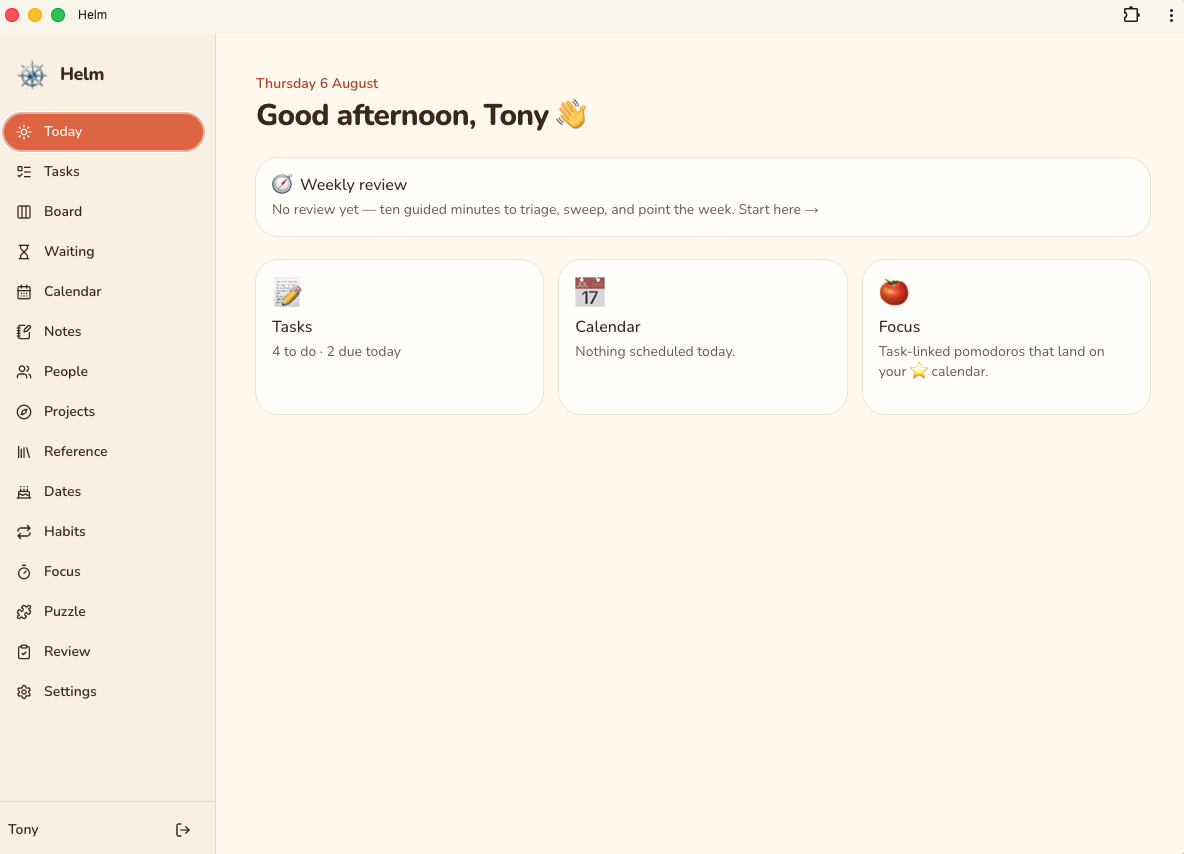
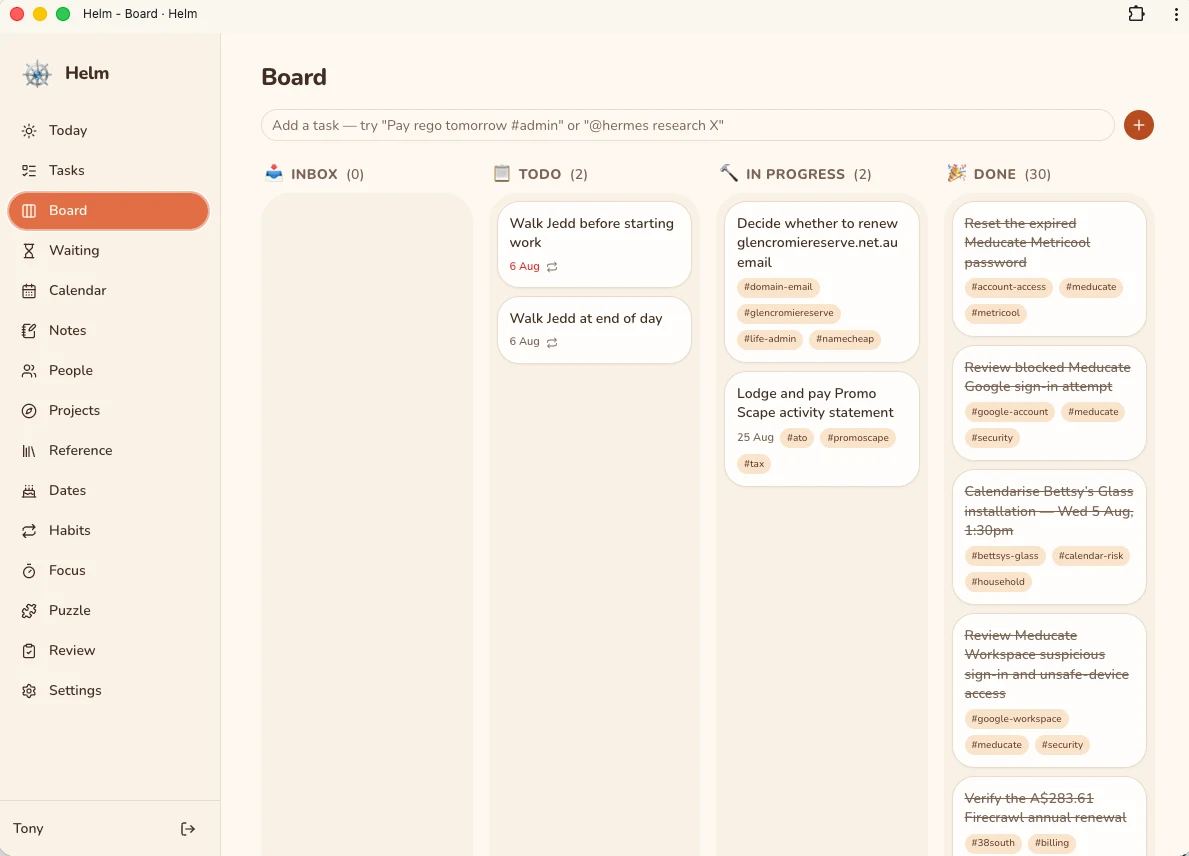
And here’s the part that matters: it exists for her alone. A dedicated server in the cloud, built around her business — not a seat on some shared system with everyone else’s data alongside it. We run and look after it as part of what she pays; we don’t see what we haven’t been given access to. And the data on it is hers: if she ever stopped, it would go with her.
It works the way she does. The conversations happen in Telegram — she messages BrieAnna the same way she’d message anyone. And when she wants to see things rather than chat about them, Helm has its own app, on the desktop and on her phone: her task board, her calendar, the whole picture at a glance. Chat for the back-and-forth, the board for the overview.
I'm not a technology person. I make cheese. I just message BrieAnna like I'd message anyone, and things get done.
BrieAnna’s day runs to the factory’s rhythm:
- 7:00am — the briefing. BrieAnna has already read all three inboxes — factory, farm, and personal — and turned anything that needs action into a task with a due date. Urgent things flagged, money in and money out tracked, today’s appointments listed. Never more than thirty lines.
- Midday — silence, usually. Unless a bill is due today or a big order just landed, BrieAnna says nothing. Kaye’s on the floor making cheese; an assistant who interrupts for nothing isn’t an assistant.
- 5:00pm — the wrap. What came in, what got cleared, what’s due tomorrow.
- 10:00pm — the pasteuriser. Every batch is tracked by a data logger taking a reading every four seconds, which it dumps into a spreadsheet — thousands of unlabelled rows per run, piling up unread in a folder. BrieAnna collects the day’s files, reads every row, renames the cryptic columns to what they actually are — temperature, flow, output, divert — and builds each batch into a colour-coded chart. Kaye wakes up to yesterday’s runs as pictures she can scan in seconds. If Safe Food Victoria ever asks for batch records, they’re labelled, charted and audit-ready.
There’s a financial rhythm too. Each month BrieAnna pulls together the profit-and-loss figures; each quarter, the BAS numbers and the cafe takings reconciled ready for the books. For those she can’t act alone — the accounting system needs a code from Kaye’s phone to open the door. That’s deliberate. The same goes for email: BrieAnna drafts replies, but nothing is ever sent unless Kaye sends it.
And she’s getting better. That’s the other thing about a Helm agent: it learns. We help train it, Kaye trains it herself just by working with it, and it gets sharper about her business every week.
The hygiene documents
One story says it best. Kaye had a set of new hygiene documents she’d been putting off for months — the kind of compliance paperwork that never feels urgent until it suddenly is, and never gets done because it takes a clear afternoon nobody in a cheese factory has.
She asked BrieAnna to look into it. Ten minutes later there was a folder of finished, ready-to-use PDFs — requirements researched, documents drafted, filed where she’d find them. The job she’d been dreading for months was done before the next batch finished.
I'd been putting off a set of hygiene documents for months — there's never a clear afternoon in a cheese factory. I asked BrieAnna and had the whole lot as finished PDFs in about ten minutes. That's when it clicked for me.
What this actually is
Kaye didn’t buy software and learn it. She got three things that fit together: a proper, sometimes uncomfortable look at her business by someone on her side; an assistant that runs on the factory’s rhythm and knows when to stay quiet; and a setup that exists for her business alone, holding data that stays hers whatever happens next.
We write the articles on Bassine’s website too. Same arrangement as everything else here: real work, done properly, that she’d otherwise have to find time for.
That’s what 38South does. If some part of your week looks like Kaye’s pasteuriser folder — valuable, invisible, and quietly eating someone’s time — that’s usually where we’d start.
Something in your business look like this? We build the software, websites, automation and AI that fix it — and the writing that goes with them.
Book a chat →